Classes & Objects
Object-Oriented Programming (OOP) is a paradigm where code is organized around "objects" rather than actions. An object contains both data (attributes) and code (methods). This lesson introduces the foundation of OOP: Classes and Objects.
Learning Objectives
- 11.4.1.1 Create classes and instances of classes
- 11.4.1.3 Use special method
__init__to set default properties - 11.4.1.2 Develop methods for the class
Conceptual Anchor
The Blueprint Analogy
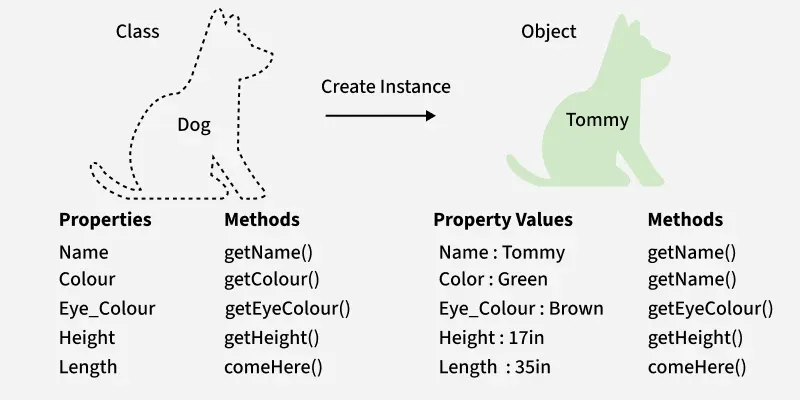
Think of a Class as a blueprint for a house. It describes what
the house should have (walls, windows) and do (open door).
An Object (or Instance) is the actual house built from that
blueprint. You can build unlimited houses from one blueprint, and each house can have different
colors or furniture, but they all follow the same structure.
Rules & Theory
Defining a Class (11.4.1.1)
class Car:
    pass   # Empty class

# Creating instances (Objects)
my_car = Car()
your_car = Car()
The
__init__ Method (11.4.1.3)
The __init__ method (constructor) runs automatically when you create a new object. It
initializes the object's attributes.
class Car:
    def __init__(self, brand, model):
        self.brand = brand   # Attribute
        self.model = model   # Attribute

# Creating objects with data
c1 = Car("Toyota", "Camry")
c2 = Car("BMW", "X5")

print(c1.brand)  # Toyota
print(c2.brand)  # BMW
Methods (11.4.1.2)
Methods are functions defined inside a class that define the behavior of the object.
The first parameter must always be self.
class Car:
    def __init__(self, brand, model):
        self.brand = brand
        self.model = model
        self.speed = 0

    def drive(self):
        self.speed += 10
        print(f"{self.brand} is driving at {self.speed} km/h")

    def stop(self):
        self.speed = 0
        print(f"{self.brand} stopped.")

my_car = Car("Tesla", "Model S")
my_car.drive()   # Tesla is driving at 10 km/h
my_car.drive()   # Tesla is driving at 20 km/h
my_car.stop()    # Tesla stopped.
What is self?
self is a reference to the current object being used. When you call
my_car.drive(), Python automatically passes my_car as the
self argument.
Modeling: OOP in Practice
Watch this demonstration of creating classes, initializing attributes, and calling methods in Python.
Worked Examples
1 Student Class
class Student:
    def __init__(self, name, grade):
        self.name = name
        self.grade = grade

    def promote(self):
        self.grade += 1
        print(f"{self.name} is now in Grade {self.grade}")

ali = Student("Ali", 10)
print(ali.grade)    # 10
ali.promote()       # Ali is now in Grade 11
2 Bank Account
class BankAccount:
    def __init__(self, owner, balance=0):
        self.owner = owner
        self.balance = balance

    def deposit(self, amount):
        self.balance += amount
        print(f"Deposited {amount}. New balance: {self.balance}")

    def withdraw(self, amount):
        if amount <= self.balance:
            self.balance -= amount
            print(f"Withdrew {amount}. New balance: {self.balance}")
        else:
            print("Insufficient funds!")

acct = BankAccount("Dana", 1000)
acct.deposit(500)     # 1500
acct.withdraw(2000)   # Insufficient funds!
3 Person Class (Age Calculator)
class Person:
    def __init__(self, name, surname, year_of_birth):
        self.name = name
        self.surname = surname
        self.year_of_birth = year_of_birth

    def print_info(self):
        print(f"Name: {self.name}\nSurname: {self.surname}\nYear of birth: {self.year_of_birth}")

    def get_age(self, current_year):
        print(f"Age - {current_year - self.year_of_birth}")

# Creating instances
user1 = Person("Azamat", "Arystanov", 1984)
user2 = Person("Karina", "Mahmudova", 2004)

user1.print_info()
user1.get_age(2024)  # Age - 40
Independent Practice
Formative Assessment
Complete the practical tasks assigned on Formative to test your understanding of Classes and Objects.
- Go to app.formative.com/join
- Enter the Join Code:
446PDV
Pitfalls & Common Errors
Forgetting self
Defining a method as def drive(): instead of def drive(self): causes a
TypeError when called.
__init__ Underscores
It is a double underscore on both sides! __init__, not _init_.
Graded Tasks
What is the difference between a class and an object? What is self?
Why do we need the __init__ method? What happens if we don't define it?
Create a class Rectangle with attributes length and width, and methods
area() and perimeter().
Design a Book class with title, author, and page count. Add a method
read(pages) that tracks current page progress.