System Life Cycle & SDLC Models
A new information system is not created in one step. Developers first identify the problem, investigate user needs, design a solution, build and test it, introduce it to users, and continue improving it after release. The System Development Life Cycle (SDLC) describes these stages, while a life cycle model determines how the stages are organised.
Learning Objectives
- 11.2.1.1 Describe the stages of the System Development Life Cycle.
- 11.2.1.2 Analyse the advantages and disadvantages of cyclical, waterfall and spiral models.
Conceptual Anchor
Building a House
Think of software development like building a house. First you identify what the client needs, then investigate the site, create a design, build the house, check that everything works, hand it over to the client and repair or improve it when necessary. Software projects follow a similar sequence of activities.
Stage vs Model
Stages describe what work is done. Models describe how the stages are organised. For example, Design and Testing are stages; Waterfall and Spiral are models.
System Life Cycle Stages
The System Life Cycle is a process of stages that occur during the development of a new ICT system. Following the stages helps an organisation understand the problem before building the solution.
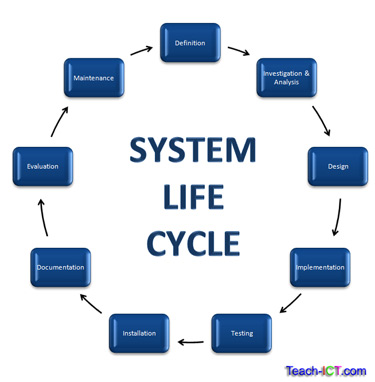
1. Definition
The first task is to define the problem. Analysts may interview management and staff to understand what is wrong with the existing system and why a new system is needed.
2. Investigation & Analysis
A detailed study is carried out to understand the existing system and the proposed new system. Questionnaires, interviews and observation can be used to collect information from users.
3. Design
After the requirements have been agreed, the team decides how the new system will work. This can include interface design, input and output design, database structure and processing rules.
4. Implementation
Developers create the new system and write the program code according to the approved design.
5. Testing
The completed system is tested to check that it works as expected. The lesson materials identify Black Box Testing, White Box Testing and Dry Run Testing.
6. Installation
The new system is introduced into the organisation so that users can begin working with it.
7. Documentation
Documentation is prepared for users and technical staff. It explains how to operate, support and maintain the system.
8. Evaluation
The completed project is reviewed. Two important questions are: Does the finished solution meet its requirements? and Does it solve the original problem?
9. Maintenance
After the system is in use, problems may need to be fixed and changes may be required when user needs or technology change.
SDLC in One Overview
What Is SDLC?
Software Development Life Cycle explained in English.
Life Cycle Models
A software life cycle model is a structure that determines the sequence of processes, actions and tasks throughout development. The most suitable model depends on the scale, complexity and conditions of the project.
| Model | Main Idea |
|---|---|
| Waterfall | Stages are completed sequentially, one after another. |
| Cyclical / Iterative | The product is developed through repeated cycles and feedback. |
| Spiral | Repeated cycles with a strong focus on risk analysis. |
| Incremental | The system is divided into modules and developed in separate increments. |
| V-Model | Development stages are linked to corresponding testing activities. |
| Agile | Flexible development using short iterations and regular customer feedback. |
Waterfall Model
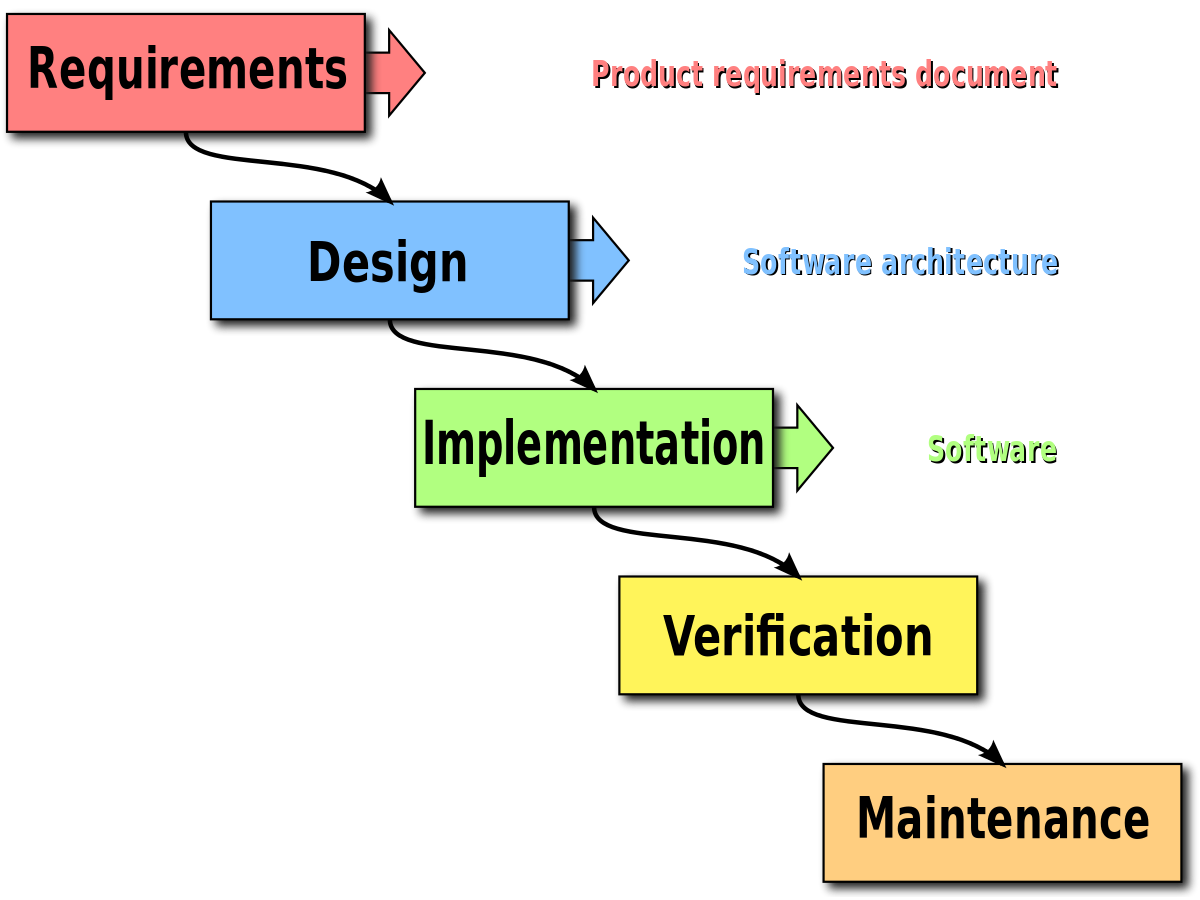
Waterfall is one of the oldest life cycle models. Development moves through a fixed sequence of stages. A stage should be completed before the next one begins.
| Advantages | Disadvantages |
|---|---|
| Stages and activities are clearly defined. | Requirements need to be understood very early. |
| The project is easier to plan and manage. | It is difficult to return to a completed stage. |
| Works well when requirements are clear and stable. | Changes later in development can be expensive. |
Waterfall Model Explained
Watch after reading the advantages and disadvantages.
Waterfall Model
Waterfall Model explained with examples.
Cyclical / Iterative Development
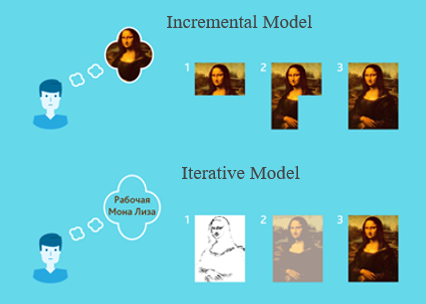
In an iterative model, development is carried out through repeated cycles. Each iteration produces a working but incomplete version of the system. Users can review the result and their feedback can lead to another development and testing cycle.
| Advantages | Disadvantages |
|---|---|
| Users can see working versions during development. | The final cost and effort can be harder to estimate early. |
| Feedback can be used to improve the next version. | Repeated changes may extend the project. |
| Problems can be discovered earlier. | Regular user involvement is needed. |
Why feedback can start a new cycle
Positive feedback can show that the current version meets user needs. Negative comments or new requirements may require another period of development and testing.
Spiral Model
The Spiral model combines repeated development with a major emphasis on risk analysis. It is useful when a project is complex, expensive or contains important uncertainties that should be investigated before development continues.
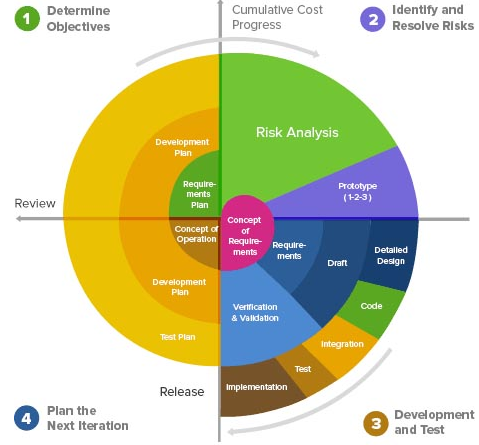
One cycle of the Spiral model
- Determine objectives for the current cycle.
- Identify and resolve risks before committing further resources.
- Develop and test the next version of the solution.
- Review and plan the next iteration.
| Advantages | Disadvantages |
|---|---|
| Risks are considered throughout development. | The model can be expensive and time-consuming. |
| Estimates become more realistic as the project develops. | Risk analysis requires suitable expertise. |
| Changes can be introduced between cycles. | It may be unnecessarily complex for a small project. |
Spiral & Incremental Models
Visual explanation of repeated-cycle development.
Spiral Model
Spiral Model and risk analysis explained in English.
V-Model
The V-Model is closely related to Waterfall. Development activities appear on the left side of the V and corresponding testing activities appear on the right. Its main focus is verification and validation.
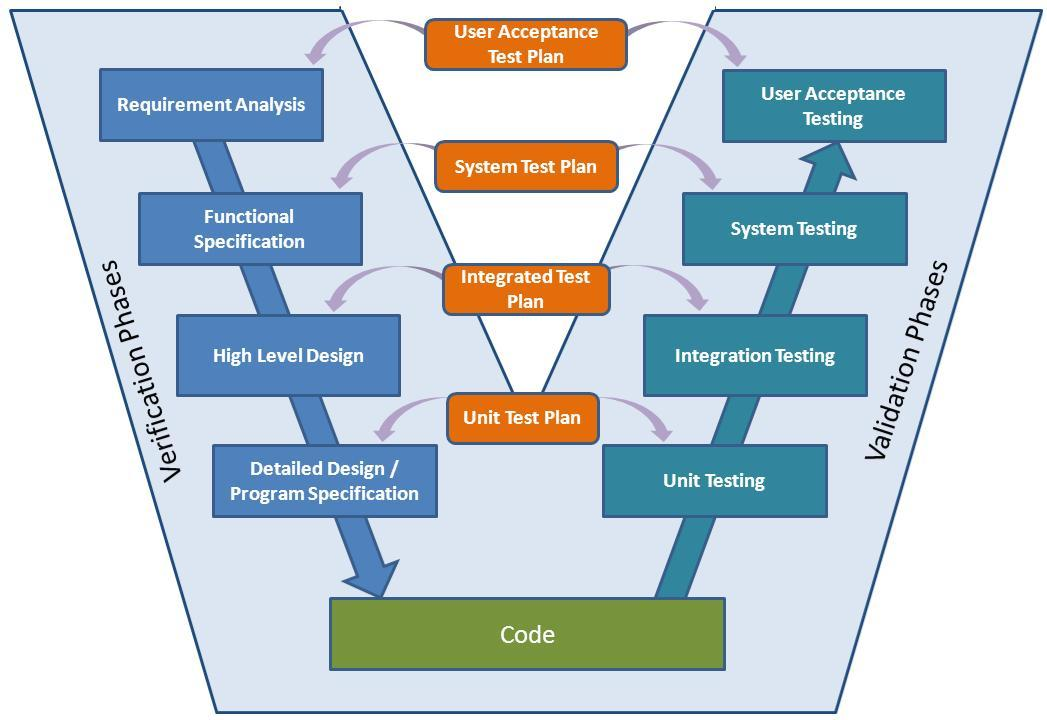
| Advantages | Disadvantages |
|---|---|
| Testing is considered early in the development process. | The model is relatively inflexible. |
| Verification and validation are strongly connected to development. | Returning to earlier stages can still be difficult. |
Incremental & Agile Development
Incremental Model
In the Incremental model, the complete system is divided into modules. Different parts are developed through separate development cycles and are later combined into the complete system.
Agile / Scrum
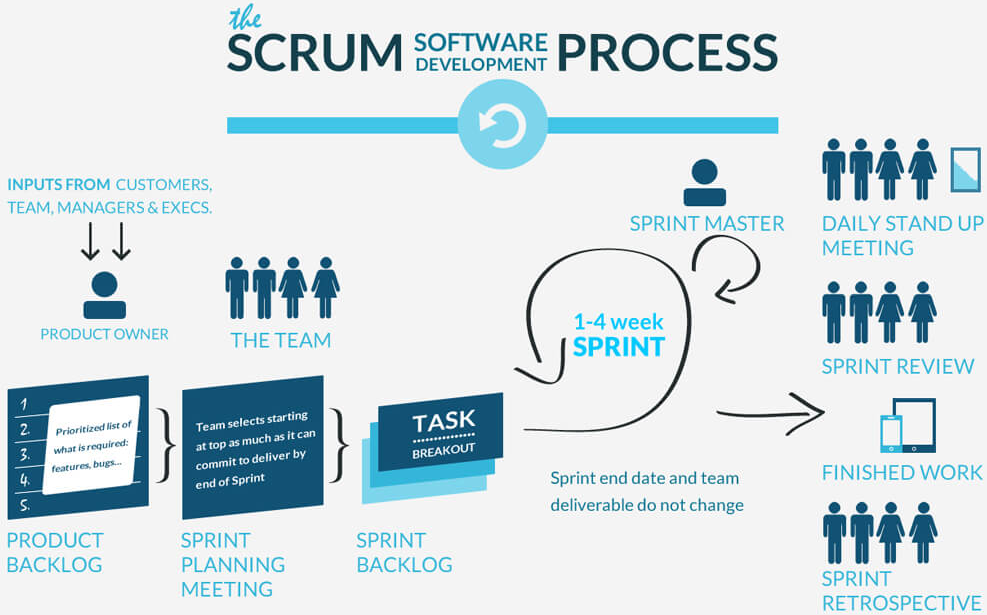
Agile is a flexible development approach in which the customer can observe progress after each iteration. In Scrum, work is organised into short development periods called sprints.
Compare the Main Models
| Feature | Waterfall | Cyclical / Iterative | Spiral |
|---|---|---|---|
| Flow | Sequential | Repeated cycles | Repeated risk-focused cycles |
| Changing requirements | Difficult once a stage is completed | Can be introduced through feedback | Can be considered between spiral cycles |
| User feedback | More limited during development | Regular feedback is important | Review helps plan the next cycle |
| Risk | Not the central feature | Problems may be found during iterations | Risk analysis is a central activity |
| Typical fit | Clear, stable requirements | Requirements may change | Complex or high-risk projects |
Worked Scenario — School Guest Registration
1 Current system
When a guest arrives at school, security records the visitor manually in a notebook. This takes time and makes it difficult to control and verify visitor information.
2 Proposed system
The client wants an electronic system. Security should take a photograph and record:
- guest name;
- IIN;
- time of arrival;
- time of departure.
The information must be stored in a database.
3 Main form design
| Interface Element | Purpose |
|---|---|
| Camera preview | Display and capture the guest photograph. |
| Name field | Enter the guest's full name. |
| IIN field | Enter the guest's identification number. |
| Arrival time | Record when the visitor enters the school. |
| Departure time | Record when the visitor leaves. |
| Save button | Store the completed record in the database. |
Model-choice question
When choosing a model, do not simply state its name. Connect a feature of the scenario to a feature of the model. For example, if users need to review early versions of the interface, explain why repeated prototypes or iterations would help.
Pitfalls & Common Errors
Stages and models are not the same thing
Testing is a stage. Waterfall is a model. A model tells us how stages are organised.
Waterfall is not automatically a poor choice
Waterfall can be suitable when requirements are well understood and unlikely to change.
Spiral is more than simply repeating stages
The important distinguishing feature of the Spiral model is the explicit analysis and reduction of risk.
Pro-Tips for Exams
Comparison questions
- Use the words sequential, iteration, feedback and risk accurately.
- Do not give an advantage without explaining why it matters in the scenario.
- For a disadvantage, explain the practical consequence for the project.
- If asked to choose a model, quote details from the scenario in your justification.
Graded Tasks
Write the nine System Life Cycle stages in the correct order.
Explain the difference between an SDLC stage and an SDLC model.
Explain how the school guest registration system could be developed using the Waterfall model.
Compare Waterfall and Cyclical development for the school guest registration system. Give one advantage and one disadvantage of each.
A company is developing a large new system with uncertain requirements and significant financial risk. Explain why the Spiral model may be appropriate.
Design the main form for the school guest registration application. Include the guest photo, Name, IIN, arrival time, departure time and controls required to save the record.